
Thrust bearings and slewing bearings serve different purposes in mechanical systems and have distinct characteristics. Here’s a breakdown of their differences:
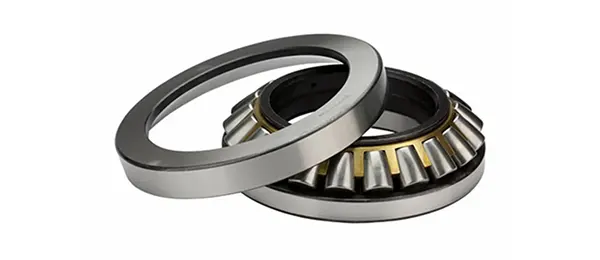
Thrust Bearing:
- Purpose:
Thrust bearings are designed to handle axial loads, which are forces parallel to the shaft. They support a rotating shaft and prevent it from moving axially.
- Types:
Thrust Ball Bearings: Use balls to maintain the separation between the bearing races.
Cylindrical Roller Thrust Bearings: Use cylindrical rollers.
Spherical Roller Thrust Bearings: Use spherical rollers.
Tapered Roller Thrust Bearings: Use tapered rollers.
- Applications:
Automotive applications (e.g., car transmissions).
Aerospace applications.
Industrial machinery.
Marine applications.
- Design:
Typically consists of two raceways (one fixed and one rotating) with rolling elements (balls or rollers) in between.
Can support high axial loads but limited radial loads.
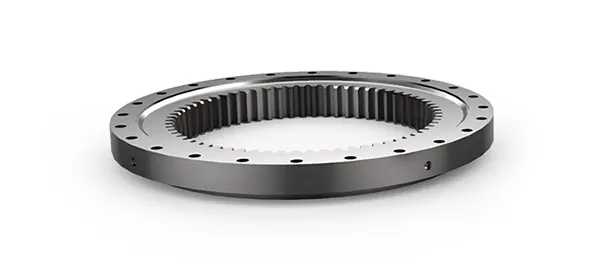
Slewing Bearing:
- Purpose:
Slewing bearings are designed to handle both axial and radial loads as well as tilting moments. They are used for slow-turning or oscillating movements, often with heavy loads.
- Types:
Single-row ball slewing bearings: Use a single row of balls.
Double-row ball slewing bearings: Use two rows of balls.
Three-row roller slewing bearings: Use three rows of rollers.
Crossed roller slewing bearings: Use rollers that are crossed at right angles to each other.
- Applications:
Cranes and excavators.
Wind turbines.
Robotics.
Turntables for heavy equipment.
Solar trackers.
- Design:
Typically includes an inner ring and an outer ring with a row (or rows) of rolling elements (balls or rollers) in between.
Can support high axial, radial, and moment loads.
Often equipped with gear teeth on the inner or outer ring to facilitate rotation.
Key Differences:
- Load Handling: Thrust bearings primarily handle axial loads, whereas slewing bearings handle axial, radial, and moment loads.
- Design Complexity: Slewing bearings are generally more complex and larger, with multiple rows of rolling elements and
- sometimes integrated gear teeth.
- Application Scope: Thrust bearings are used in applications with significant axial load but limited radial load, while slewing bearings are used in applications that require handling of complex load combinations and often involve large, heavy equipment.