
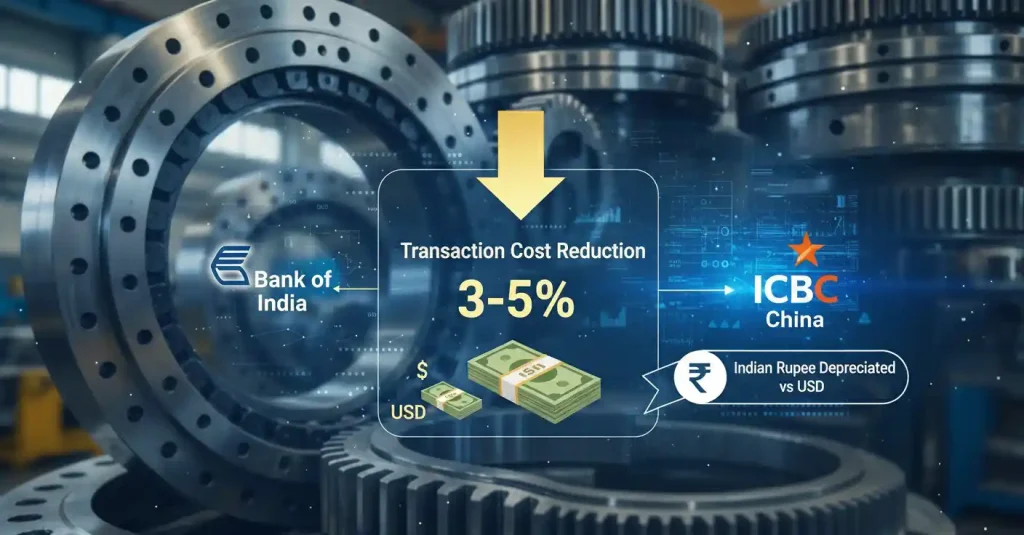
In theory, this mechanism may help industrial buyers reduce transaction cost by up to 3–5%, especially under the current situation where the Indian Rupee has depreciated significantly against the US Dollar.
However, from our practical experience in international engineering supply, the execution path is more important than the policy itself.
In reality, the typical settlement route is:
Indian company → Indian bank → Indian bank’s China branch → Chinese bank → Chinese supplier
The most critical bridge in this chain is the Indian bank’s China branch.
If the Indian bank has a mature clearing channel in China and is allowed to remit RMB or Rupee to its China branch, the final settlement to the Chinese seller becomes feasible through local interbank exchange.
At present, this channel is still under development and not fully standardized.
Processing speed, exchange rate mechanism, and compliance approval depend heavily on each individual bank’s clearing capability.
In theory, the route is clear.
Russia has already implemented similar local currency settlement successfully with VTB BANK in shanghai(Shanghai Tower).
But for India–China trade, the system is still in a transitional stage.
As a long-term supplier for international water and wastewater treatment projects and heavy equipment manufacturers, we believe that settlement method is part of project success, not only a financial topic.
Before choosing RMB–Rupee settlement, we strongly recommend our partners to:
- First connect with their Indian bank and confirm whether a China branch clearing channel is available
- Clarify remittance approval and exchange mechanism in advance
- Coordinate with the Chinese receiving bank before contract signing
At ZZ Manufacturing, we not only supply slewing bearings and drive systems.
We also help our partners evaluate transaction feasibility, currency risk, and settlement efficiency — ensuring every international project runs smoothly from engineering to payment.