
An Engineering & Supply Chain Insight by ZZ Slewing Bearing
Executive Summary
Over the past months, China’s raw material market has entered a strong upward cycle, especially for strategic metals such as tungsten, manganese, zinc and alloy steels. Combined with currency fluctuations, production costs for slewing bearings and forged components are rising rapidly.
Based on market data and ZZ Slewing Bearing’s long-term manufacturing experience, we expect a cost-driven demand surge within the next 4–5 months across heavy equipment, water & wastewater treatment, and infrastructure sectors.
Early ordering is now the most effective strategy to control cost and delivery risk.
1. China Steel & Alloy Price Trend
General steel prices remain volatile, while alloy and tool steel prices show a clear upward trend driven by supply tightening and environmental regulations.
2. Tungsten Price Explosion – The Core Cost Driver
Tungsten is a critical raw material for: Carbide cutting inserts
– Forging and machining tools
– Wear-resistant tooling used in slewing bearing production
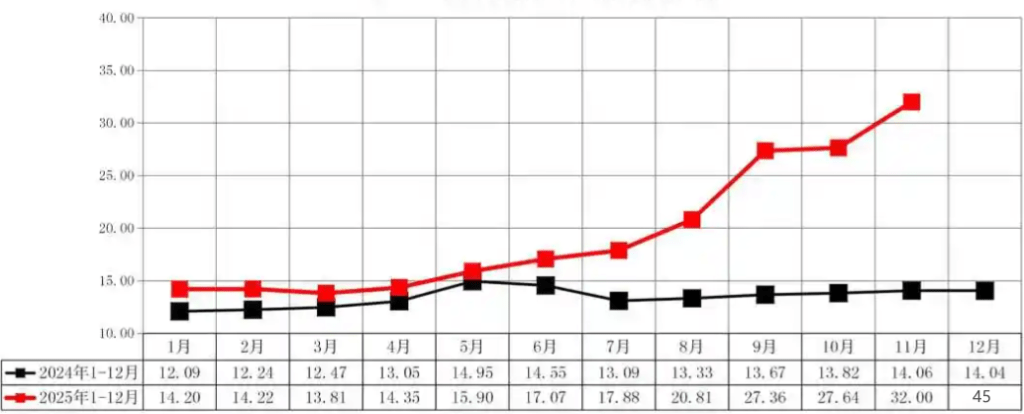
In China, tungsten concentrate and APT prices have increased by over 100% – 200% year-on-year, reaching historical highs.
China Tungsten Concentrate & APT Price Trend (2024–2026)
→showing sharp price growth exceeding 100%.

Caption:
Rapid tungsten price escalation directly raises tooling and machining costs for large forged components such as slewing rings.
3. Exchange Rate Effect – Hidden Cost Pressure
Besides raw materials, currency movement adds another layer of cost risk:
- The USD–CNY exchange rate remains volatile
- When USD weakens below 7.0 against CNY, USD-denominated manufacturing cost increases
- Estimated impact: ~5% higher cost in USD terms compared with last year
USD / CNY Exchange Rate Trend & Manufacturing Cost Impact
→exchange rate vs. estimated USD cost index.
Caption:
Currency fluctuation amplifies raw material inflation and directly affects export pricing.
4. Why Slewing Bearings Are More Sensitive to This Cycle
Unlike standard steel structures, slewing bearings require:
- High-precision forging
- Extensive CNC machining
- Heavy use of tungsten-based cutting tools
- Multi-stage heat treatment and finishing
This means:
- Tooling cost increases faster than base steel
- Production cycle becomes more expensive and longer
- Price transmission to downstream products is unavoidable
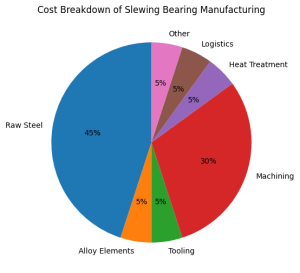
Slewing Bearing Cost Structure Breakdown
(Pie chart: Raw steel / Alloy elements / Tooling / Machining / Heat treatment / Logistics)
Caption:
Tooling and alloy elements represent a disproportionately high share of cost in precision slewing bearings.
5. Market Outlook – A Likely Demand Surge in 4–5 Months
Based on historical cycles and ZZ Slewing Bearing’s market observation:
- Raw material inflation usually triggers advance purchasing behavior
- EPC contractors and equipment manufacturers stock up before further price increases
- Lead times extend as capacity becomes constrained
We expect a concentrated order surge (“blowout growth”) within the next 4–5 months, especially in:
- Water & wastewater treatment plants
- Heavy construction machinery
- Mining and mineral processing equipment
6. Strategic Recommendation from ZZ Slewing Bearing
Due to the combined effect of:
- Tungsten price rising more than 100%
- Alloy metal tightening
- Exchange rate uncertainty
- Expected capacity congestion
We strongly recommend:
- Secure production slots early
- Place Q1 and Q2 orders in advance
- Lock pricing before the next cost adjustment cycle
This is so important that we repeat it three times:
Place your order as soon as possible.
Place your order as soon as possible.
Place your order as soon as possible.
7. Conclusion
The current raw material cycle marks the beginning of a new cost-driven phase for the heavy equipment and slewing bearing industry. With tungsten and alloy prices breaking historical levels, the downstream market is entering a sensitive window where early planning will define competitiveness.
At ZZ Slewing Bearing, we continuously monitor raw material markets, tooling costs and exchange trends, helping our partners make informed procurement decisions and secure stable supply in volatile cycles.