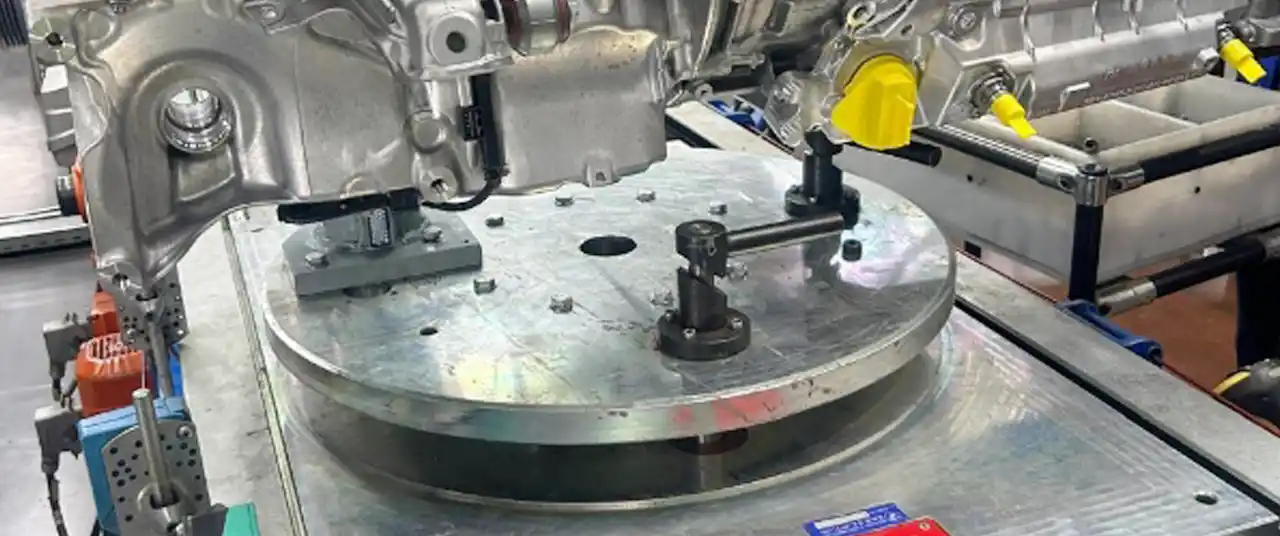

This sentence is not a slogan. It comes from many real failures, site inspections, and rework cases over the years.
In slewing bearing applications, problems rarely start from the bearing itself.
Most of them start from the installation system.
-
A short look back: why early slewing bearings often failed early
When slewing bearings were first widely used in cranes, radar systems and construction equipment, engineers believed one thing:
If the bearing is strong enough, it should last.
So the common approach was:
- Thick rings
- High hardness
- More bolts
On paper, everything looked correct.
But in real projects, engineers noticed something strange:
The same bearing model,
under the same load,
working in similar conditions,
could have very different service lives.
Some worked for many years.
Others failed after a short time.
After many failures were taken apart and studied, one conclusion became clear:
The bearing design was not the real problem.
The installation condition was.
-
Mounting surface: the real bearing killer
2.1 “Flat enough to assemble” is not flat enough to work
In calculations, load is assumed to be evenly distributed around 360°.
In reality, if the mounting surface has:
- Poor flatness
- Local high or low spots
- Welding stress not released
- Uneven stiffness of the supporting structure
then the load will never be uniform.
Instead, it concentrates in small areas.
2.2 Failure does not happen immediately — it happens slowly
A bad mounting surface usually causes a slow chain reaction:
- Local contact stress increases
- Small indentations appear on raceways and rolling elements
- Noise starts during rotation
- Friction becomes uneven
- Torque fluctuates
At the end, the bearing may seize, spall, or crack.
This is why mounting surface problems are dangerous:
they kill the bearing slowly, not suddenly.
-
Pilot (shoulder): the silent killer of gear mesh
If the mounting surface decides whether the bearing can survive,
the pilot decides whether the gear system can work correctly.
Many people think the pilot is only for positioning.
That is a serious misunderstanding.
3.1 What the pilot really controls
In a slewing bearing with gear, the pilot controls:
- Concentricity between bearing and drive
- Stability of gear backlash
- Load distribution on gear teeth
If the pilot has:
- Diameter error
- Poor roundness
- Misalignment to the mounting surface
then gear meshing changes.
Instead of smooth line contact,
the teeth start to hit each other at local points.
3.2 Why gear damage often appears later, but looks worse
In many real cases, the sequence is very similar:
- First, abnormal noise
- Then vibration
- Finally, tooth cracking or breakage
The gear itself is often blamed.
But in most cases, the real reason is:
Poor pilot → eccentric meshing → uneven tooth load → fatigue failure at the tooth root
This is why gear failures often look sudden,
but the damage has been building for a long time.
-
A key change in understanding: from “bearing problem” to “system problem”
One important change in the industry is this:
A slewing bearing is not a single part.
It is a system, including:
- Mounting surface
- Pilot
- Bolts
- Drive system
- Lubrication
This explains why identical bearings can perform very differently in different projects.
The difference is not luck.
It is system control.
-
Practical rules that actually work
From real production and site experience, several rules are critical:
- Machine the mounting surface first, then drill mounting holes
- Control flatness based on load and overturning moment, not only general tolerance
- Treat the pilot as a functional reference, not just an assembly aid
- Machine the bolt circle and pilot in one CNC setup whenever possible
- Check real installation conditions, not only drawings
These steps are simple, but often ignored.
-
The most dangerous part: what you cannot see
More than 90% of serious slewing bearing failures cannot be found at delivery or installation.
When noise or vibration appears,
the damage is already inside the system.
At that stage, repair is difficult and expensive.
Final conclusion
A bad mounting surface kills the bearing.
A bad pilot kills the gear mesh.
Good slewing bearing performance does not come from higher numbers on a drawing,
but from controlling the details that most people do not see.